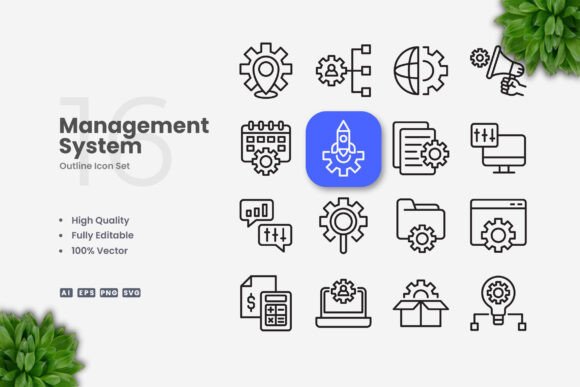
Management System Icons and Simple, Clean Icon Design for Modern Projects
When it comes to visual communication, icons play a crucial role in conveying complex ideas quickly and effectively. Management system icons are especially valuable in digital and print media, offering clarity and consistency across various platforms. A well-designed icon set can elevate the user experience, enhance brand identity, and streamline workflows. The right management system icons should be simple, clean, and adaptable to fit different design needs.
Simple and clean icon design is more than just an aesthetic choice—it’s a practical approach that ensures usability and versatility. These icons are designed with minimal details, making them easy to recognize at any size. Whether you're creating a website, mobile app, or infographic, clean icons maintain their clarity without becoming visually overwhelming. This makes them ideal for use in a wide range of applications, from social media posts to printed materials like flyers and posters.
Key Features of High-Quality Management System Icons
High-quality management system icons are typically built with vector graphics, ensuring they remain sharp and scalable regardless of the size at which they’re used. Vector files allow for seamless resizing without loss of quality, making them perfect for both digital and print projects. These icons are also 100% customizable, meaning you can adjust colors, stroke weights, and other elements to match your specific design requirements.
One of the most significant advantages of these icons is their editable stroke feature. This allows designers to modify the thickness of lines, adding depth or simplifying the design as needed. Whether you’re working on a website layout or a mobile application interface, this level of flexibility ensures that the icons integrate seamlessly into your existing design language.
For users who prefer drag-and-drop functionality, the files included in a management system icon set are often optimized for quick integration. This means you can easily import them into design software like Adobe Illustrator or CorelDRAW, making the process of editing and using the icons straightforward and efficient.
Comprehensive File Support for Different Needs
A reliable management system icon set usually includes multiple file formats to suit different design needs. Source files in Adobe Illustrator (AI) format provide full editing capabilities, while EPS Version 10 files ensure compatibility with a wide range of graphic design tools. SVG files are ideal for web use, as they support scalability and transparency, making them perfect for responsive websites and digital interfaces.
PNG files with transparent backgrounds are another essential component, allowing icons to be placed on any background without visible edges. This is particularly useful for social media content, banners, and infographics where the icon needs to blend seamlessly with surrounding elements. A README.txt file is also commonly included, offering guidance on how to use and customize the icons, ensuring a smooth workflow for designers of all skill levels.
Applications of Management System Icons in Various Industries
Management system icons are widely used across industries, from corporate environments to educational institutions and healthcare facilities. In the business sector, these icons help visualize processes, roles, and systems, making information more digestible for employees and clients alike. For example, a project management platform might use icons to represent tasks, deadlines, and team members, improving user navigation and engagement.
In education, management system icons can simplify the presentation of course structures, administrative procedures, and student resources. They are also valuable in healthcare settings, where clear visual cues are essential for patient instructions, medical equipment identification, and staff organization. The simplicity of these icons ensures that they are accessible to people of all ages and backgrounds, promoting inclusivity and ease of use.
For digital product designers, management system icons serve as a foundational element in user interface (UI) design. They help create intuitive navigation, reduce cognitive load, and enhance the overall user experience. Whether you're developing a mobile app, a website, or a software dashboard, these icons contribute to a cohesive and professional look.
Best Practices for Using Management System Icons
To get the most out of management system icons, it’s important to choose a set that aligns with your design goals and project requirements. Start by considering the context in which the icons will be used. Are they for a website, a mobile app, or a printed document? Each medium may require slight variations in style, size, or color to ensure optimal visibility and impact.
Another best practice is to maintain consistency in your icon usage. If you’re using a set of management system icons, make sure they follow a unified style—whether that’s flat design, outlined shapes, or filled illustrations. Consistency helps reinforce brand identity and improves user recognition of key elements.
When customizing icons, keep the original design principles in mind. Avoid overcomplicating the visuals, as this can reduce their effectiveness. Instead, focus on subtle adjustments that enhance clarity and alignment with your overall design scheme. Testing the icons in real-world scenarios can also help identify any potential issues before finalizing the design.
Choosing the Right Icon Set for Your Project
When selecting a management system icon set, consider factors such as scalability, customization options, and file compatibility. A high-quality set should offer a variety of icons that cover common management-related concepts, such as leadership, operations, planning, and communication. This ensures that you have the right visual tools for different aspects of your project.
Additionally, look for icon sets that come with detailed documentation and support. A well-organized README file can save time and prevent confusion during the implementation process. Some providers also offer customer support or tutorials, which can be helpful for users who are new to working with vector graphics or design software.
Ultimately, the goal is to find a management system icon set that not only meets your technical needs but also enhances the visual appeal and functionality of your project. By investing in a versatile and well-designed collection, you can create more engaging and effective designs across multiple platforms and mediums.